The Boy and the Filberts
A story of temperance · About 4 minutes
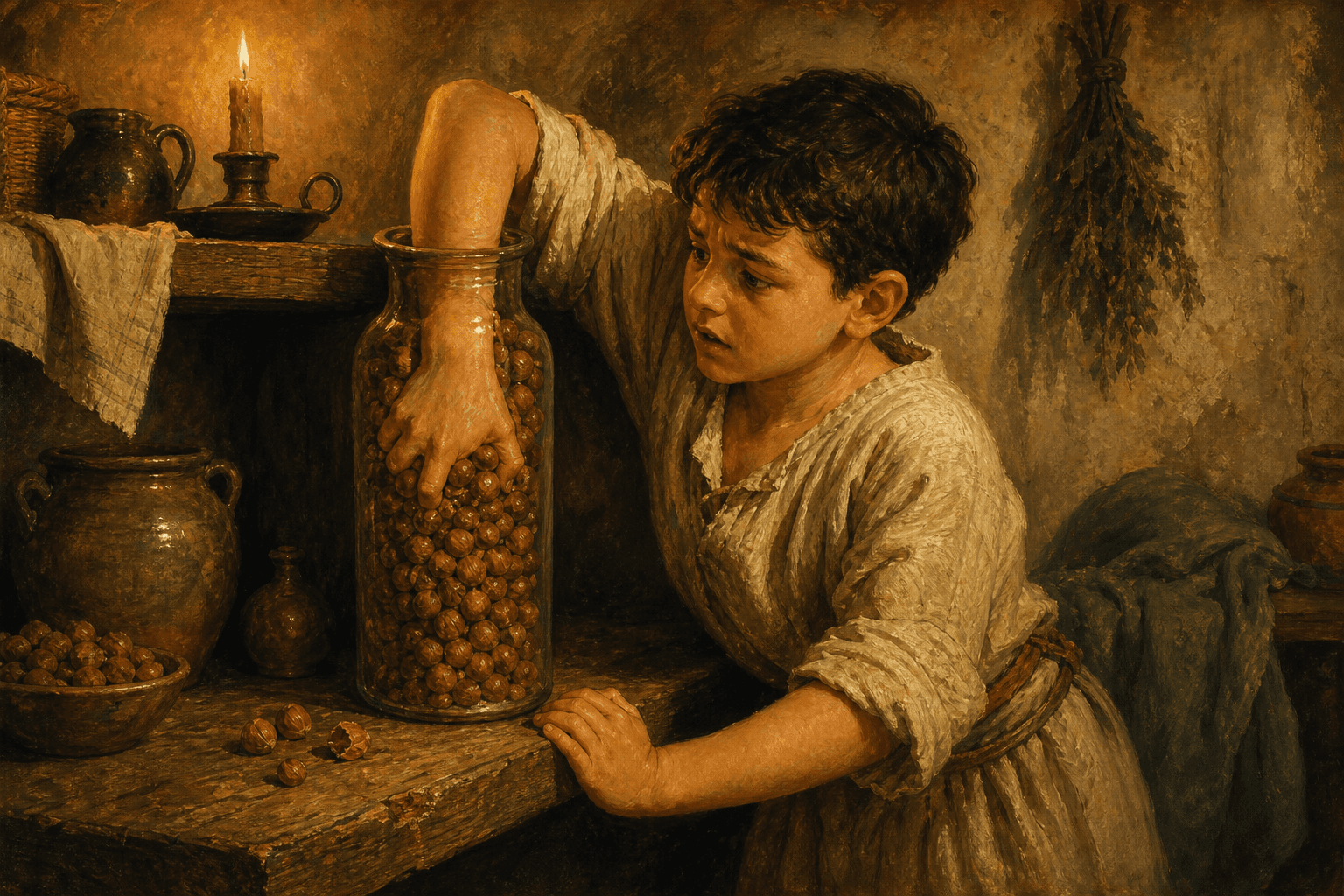
The boy found the jar on the high shelf where his mother kept the filberts, and he could not believe his luck. It was nearly full, brown hazelnuts heaped to the brim, more than he had ever seen in one place. The neck of the jar was narrow, just wide enough for a boy's hand, and his hand was already reaching.
He plunged it in, up to the wrist. Then he opened his fingers wide and closed them around as many filberts as his fist could possibly hold, and then a few more, packed in tight against his palm, until not one nut could have been added. This was the whole of his plan, and it was a fine one: take everything at once, and never have to reach again.
He pulled.
His hand did not move.
He pulled harder, bracing his other arm against the cool clay of the jar, and still it would not come. The fist that had gone in so easily was now a knot too large for the narrow neck, and the harder he tugged the more it caught. He could feel each nut pressed against the rim, the whole crowded handful wedged fast. He would not open his fingers. He had filled them so carefully; to let go now seemed like losing everything he had already won.
So he stood there with his arm swallowed to the wrist, and he pulled, and he grunted, and at last, because he was small, and tired, and the filberts would not come, he began to cry.
His mother heard him from the next room and came to see. She did not scold him, and she did not pry his hand loose. She knelt down beside the jar so that her eyes were level with his, and she looked at the trapped fist for a moment as if it were a small and solvable puzzle.
"You have taken too many," she said gently. "No wonder you cannot draw them out."
"But I want them all," he said.
"Then you will keep none, and your hand besides." She put one finger lightly on his wrist. "Take half. Be content with half, and your hand will come free, and half a fistful of filberts is a great many for a boy your size."
He did not want to. He had counted them, in a way, by the ache in his fingers, and every one he gave back felt like a nut stolen from him. But his arm was tired, and the jar would not give, and his mother's voice was steady and certain in a way that made the giving-up sound almost like a clever trick.
So he let some go.
He felt them tumble from his fingers and rattle back down among the rest. Not all of them, just enough. The knot of his fist grew smaller. And when he drew his hand back toward the narrow neck, it slid through clean and easy, and came out into the light full of filberts after all: fewer than he had grabbed, more than he could eat in one sitting.
He sat down on the floor with his back against the shelf and cracked them open one by one, and they were very good.
The Moral of the Story
We all know the boy's mistake, because we have all made it: reaching for everything at once and ending up stuck, our hand caught on our own grasping. Temperance is the loosening of that grip: the self-control to want a little less on purpose, and the quiet surprise of finding that less, held gently, is so often enough.